What is Business Personal Property Tax (BPPT) for Your Microgreen Farm?
Published
Written by Garrett Corwin
Summarize with AI
Introduction
A few years ago, I learned about the strangest type of tax levied on business owners. I’m talking about Business Personal Property Tax (BPPT). Despite the word “Personal” in the middle there, BPPT is a tax applied to business assets. In short, governments will charge a tax on the total depreciated value of assets owned by your business. As with most government oversight, the specifics will vary from state to state and county to county. For this article, we’ll use my business, Piedmont Microgreens, located in Durham County, NC. We’ll use my real BPPT bill from 2025, and we’ll talk briefly about where BPPT comes from and how to get a rough calculation of your bill.
Disclaimer
This blog is meant to provide information, NOT advice. I shouldn’t have to say this, but this article is in no way financial, tax, or business advice.
The Basics of BPPT
Why does BPPT exist? For the same reason any tax exists. Taxes exist to fund government projects, programs, and infrastructure. From the government’s perspective, the assets/equipment of your business generate revenue. Revenue relies on public infrastructure. Therefore, equipment is taxed each year to continue funding said public infrastructure. If we wanted to apply this logic to resident non-business owners, it would sound like this. You buy a new home and you fill it with furniture costing $30,000. Of course, you pay sales tax on all that furniture at checkout. A year later, you get a bill from the county charging you taxes on the depreciated value of your furniture. Let’s say it’s now valued collectively at $22,000. The county applies a 1% rate, which brings your bill to $220. That might sound insignificant, but it might also sound unfair and invasive. Not to mention, businesses can have assets valued in the range of hundreds of thousands to millions of dollars. Without going too far down the rabbit hole, I want to address what you might be thinking. “But home owners pay property tax on their real estate, if they’re a home owner!” You’re right, but so do business owners, if the business owns the real estate it presides in. Otherwise, someone renting a home doesn’t pay property tax, so your point is moot. The distinction, of course, is that homeowners are taxed on real property, while businesses are ALSO taxed on productive personal property. Regardless of your political views, BPPT could exist in your city/county, and I don’t want you to be caught off guard if/when that bill comes due.
Here’s how my county, Durham County, lays it out in their own words. This is a consolidated block of text from the Durham County Tax Administration website.
“Business personal property tax in Durham County applies to all tangible property used in a trade or business, including machinery, equipment, furniture, fixtures, computers, software treated as a capital asset, leasehold improvements, supplies, and appliances in rental properties…Certain property is exempt from taxation, including real and personal property used for religious, educational, charitable, or scientific purposes, as defined under North Carolina General Statutes. However, exemption does not excuse the requirement to file a listing. Inventories held for sale in the regular course of business—such as raw materials, goods in process, and finished goods—are also exempt…Businesses must list all assets used in their operations, including tools, office supplies, cleaning supplies, and furnishings in rental units. Construction in progress (CIP) and leasehold improvements, such as security systems, kitchen equipment, and HVAC systems for special-purpose areas, must also be reported.”
BPPT attaches to where the assets are physically located, not where the entity is registered. That means it doesn’t matter if you’re a remote business, multi-location, or home-based. It also doesn’t matter if you’re a sole proprietor, an LLC, or a C-Corp, you are required to pay BPPT if you have “tangible property used in trade or business.” As farmers, we very much have tangible assets. Funny enough, the website even says, “Farmers, carpenters, and mechanics who own tools and equipment used in a trade or business should list.”
Obviously, I’m writing this from North America, so I have no idea if BPPT exists in other countries, what it’s called, or how severe it is. However, it doesn’t appear that all US cities or counties have BPPT. As with my other articles about zoning, food safety, insurance, and businesses licenses, please do your own research specific to your area. That being said, here’s what I found.
| Likely DO Charge BPPT | Unclear or Absent for Small Businesses/Small Asset Totals | Likely DON’T Charge BPPT |
|---|---|---|
| Alabama | California | Delaware |
| Arizona | Connecticut | Illinois |
| Arkansas | Florida | New Jersey |
| Colorado | Idaho | New York |
| Georgia | Maine | Pennsylvania |
| Indiana | Massachusetts | Hawaii |
| Iowa | Montana | |
| Kansas | Nevada | |
| Kentucky | New Hampshire | |
| Louisiana | New Mexico | |
| Maryland | North Dakota | |
| Michigan | Oregon | |
| Minnesota | Rhode Island | |
| Mississippi | South Dakota | |
| Missouri | Vermont | |
| Nebraska | Washington | |
| North Carolina | Wyoming | |
| Ohio | ||
| Oklahoma | ||
| South Carolina | ||
| Tennessee | ||
| Texas | ||
| Virginia | ||
| West Virginia | ||
| Wisconsin |
BPPT is usually administered on a city AND/OR county level. This means you should check both the city and county you reside in to determine if you owe BPPT. Yes, you can have two BPPT bills if both your city and county charge this tax. Now that we have a grasp of what BPPT is and where it comes from, let’s look at a real example.
Calculating Your BPPT Bill
I didn’t know what BPPT was until many years into my business when my new CPA mentioned it. They put together the listing you’ll see below, which means I know it’s more accurate than if I’d done it myself. First, though, what’s the BPPT rate in my area? According to the Durham County Tax Administration website, “The tax rate for the 2025–2026 fiscal year in the corporate limits of Durham City is $0.9913 per $100 of assessed value.” In other words, 0.99%, which we’ll round to 1%.
A few other things to note. (i) BPPT is paid retroactively, meaning you pay taxes on assets purchased and owned in the prior year(s). For example, I recently filed my 2026 BPPT forms for assets purchased and owned at the end of 2025. (ii) BPPT is applied to ALL of your assets, not just assets acquired in the prior calendar year. (iii) BPPT usually applies to the DEPRECIATED value of the assets, but the government decides on the depreciation schedule. (iv) If you sell assets, you get to remove their value from your asset list and you won’t be taxed on them.
Before I show you my 2025 BPPT forms, please remember that I am not a CPA, nor is this legal advice in any way, shape, or form.

I don’t remember how my CPA came up with these numbers. I presume they’re aggregate numbers supplied by me and pulled from certain accounts in our bookkeeping software. However, $50,000 ($49,833) for machinery and equipment feels appropriate.
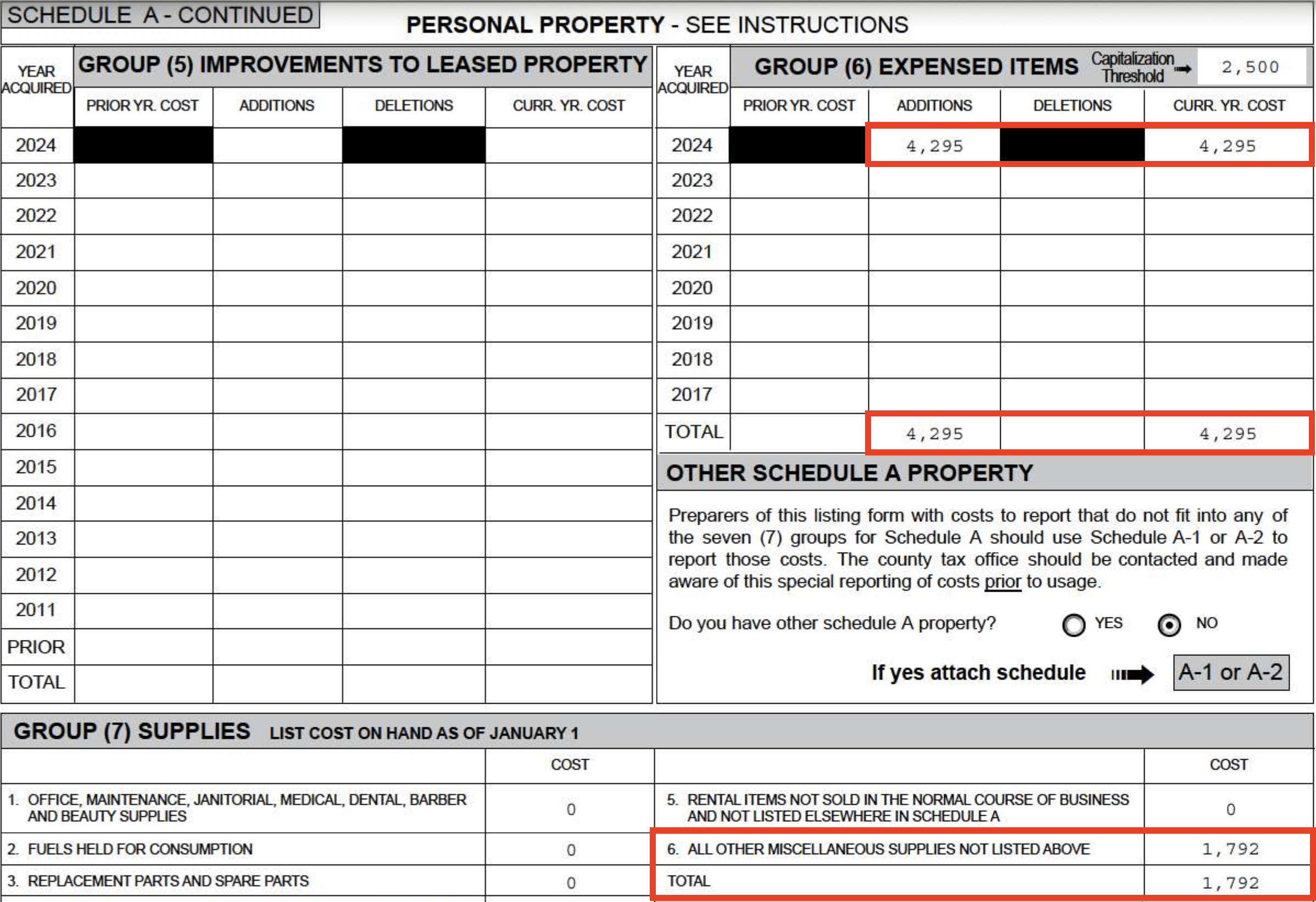
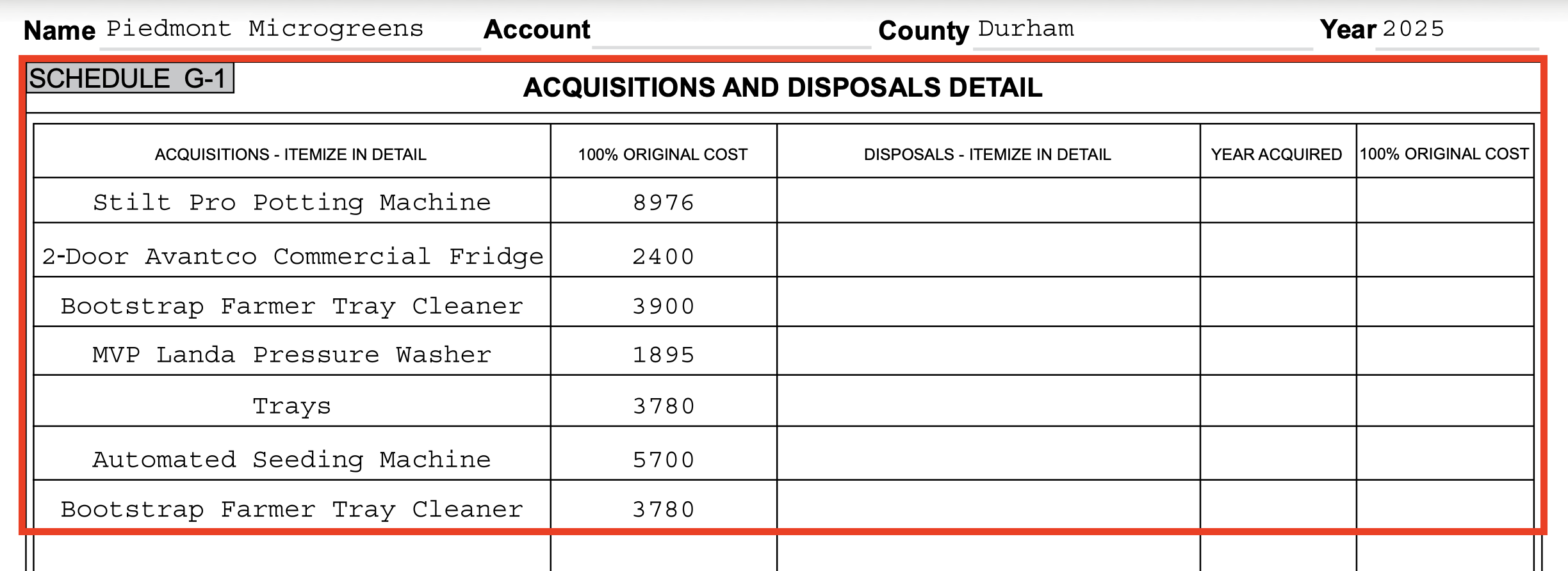
Below is the actual amount my business was charged for BPPT last year - $521.55. If we reverse engineer this into a “tangible property” value, we get $52,155. Again, that checks out based on the asset values listed in the forms above.
$521.55 (Tax Amount) / 1% (Tax Rate) = Tangible Asset Value
You also need to remember that BPPT is calculated based on the DEPRECIATED value of the assets. I’m presuming the county didn’t apply any depreciation to my assets because last year was the first year we submitted a BPPT filing. I’m surprised we didn’t get hit with any penalties for not filing in 2020-2024, but there might be a nuance I’m not aware of.

In Summary
- Business Personal Property Tax (BPPT) is a tax levied on your business assets
- BPPT is usually levied by your local city and/or county
- BPPT rates are usually between 0.5-2% of the total depreciated asset value
- Not all cities/counties charge BPPT. Reach out to your local tax administration offices
- When in doubt, hire a CPA to handle BPPT for your business
- Ignorance of BPPT is not an excuse for not filing. You can be charged penalties
Related Articles
A Comprehensive Guide to the GAP Certification for Microgreen Farmers
What Insurance Is Needed To Start a Microgreens Business?
What is Sales Tax Exemption & How to Get It for Your Microgreen Farm?
Share this post: