How to Explain “Grown-to-Order” to Your Customers (Free Download)
Written by Garrett Corwin
Summarize with AI
Introduction
If you sell microgreens to restaurants or wholesale accounts, you've probably explained the grown-to-order model more times than you can count. The chef wants product on Friday. Depending on what crops they want, you needed to know weeks ago when you were planting. They ask why you can't just harvest what’s growing or “pull it from inventory”. You explain that there is no “inventory.” You go on to explain that grown-to-order means you grow exactly what they want on a preset cadence, which means it’s always ready and earmarked just for them. This method guarantees they always get what they want, and you don’t waste time and money overproducing microgreens. Unfortunately, this model is still unfamiliar to most chefs, which means you need to do a little educating to get them to understand the benefits. We made a simple one-page guide to bring with you during each meeting with the hope that it’ll make the explanation a bit easier.
What Does Grown to Order Actually Mean (Free Download)
What It Is
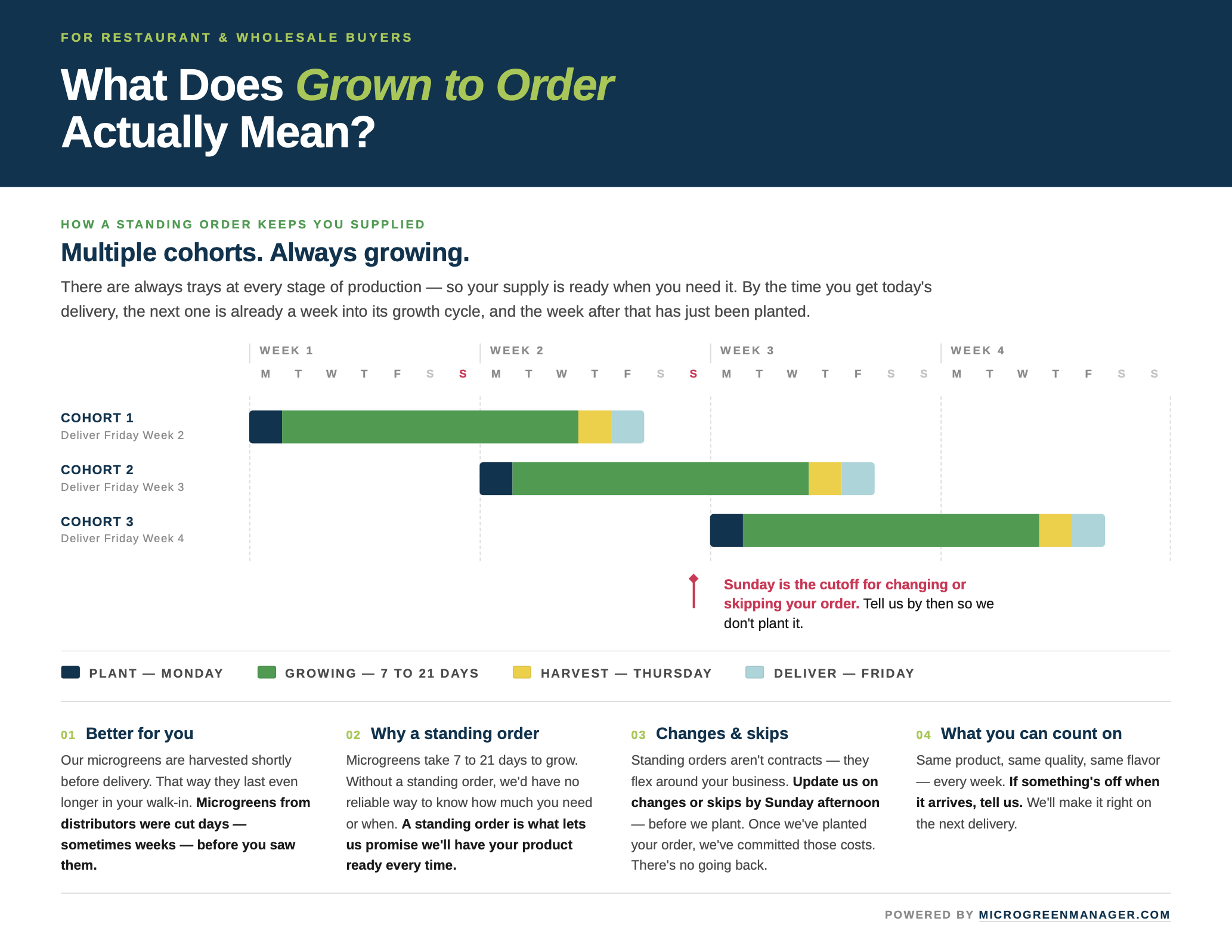
A one-page, landscape, print-ready PDF that explains the grow-to-order model and “standing orders” in plain English. It walks a buyer through the three core ideas - how production actually works, why you need a standing order to guarantee availability, and how changing or skipping an order fits into your farm’s grow cycle.
The centerpiece is a visual timeline showing three overlapping cohorts of microgreens in production at the same time. Seeing it this way should help them understand the production model in a way that no amount of verbal explanation usually does.
If you’re reading this and thinking, “I also don’t know what grown-to-order means,” we wrote a blog for that as well - What Does “Grown-to-Order” Microgreens Mean?
A Few Notes
It's illustrative, not customizable. The handout shows a Monday planting, Friday delivery, and Sunday cutoff because we had to pick something. Your specifics — your actual cutoff time, your delivery days, and your lead times — are something you'll communicate verbally, when you finalize the details with each customer. The handout isn't a reference card the chef will pull out on Tuesday to figure out whether they can still skip Friday's order. It's a teaching tool that makes the system click in 30 seconds.
It's a sales aid, not an operational document. Once the chef understands the model, you need to be specific about the nuances of your farm. The job of the handout is to communicate how the model works, not how it works specifically with your farm.
How to Actually Use It
During a new sales pitch. Pull it out when the chef pushes back on lead times or asks why you can't "just keep some on hand." Walk them through the cohort timeline once and most of their objections will disappear.
During account onboarding. Include it in your welcome packet for new restaurant or wholesale accounts alongside your menu. It will help set expectations on day one instead of after three weeks when they’re confused and frustrated.
When a new chef takes over an existing account. You've trained the original chef, they leave, the new one shows up and doesn't understand why your lead times are what they are. Hand them the PDF, walk them through it once, and you're all set.
Keep a laminated version. A physical copy you pull out at the right moment in a sales conversation gives you something tangible to point at. Some growers have told us this works better than a digital version because you can sketch on the laminated copy with a dry-erase marker — circle your actual cutoff day, write in their delivery date, walk them through it, then take it with you when you leave.
What We Hope This Does
Grown-to-order microgreens are a better product than what comes through distribution. Chefs who understand the model become better customers — more flexible, more loyal, less likely to churn over a missed delivery or a misunderstood lead time. The friction usually isn't the model itself, it's the gap in understanding.
What Does Grown to Order Actually Mean (Free Download)
Related Articles
What Does “Grown-to-Order” Microgreens Mean?
The Microgreen Farmer's Starter Kit (Buy Guide)
How to Price Microgreens: A Framework for Chefs, Retailers, and Distributors (Workbook Included)
Share this post: