Mileage Tracking for Microgreen Businesses: A Simple, IRS-Compliant Guide
Published
Written by Garrett Corwin
Summarize with AI
Introduction
If you’re in the first few years of your microgreen business, it’s likely you don’t yet own a company vehicle. If that’s the case, you’re picking up supplies, running company errands, and making deliveries using your personal vehicle. Every time you hop in the car for business reasons, you impose business expenses on a personal asset. Those expenses primarily include gas and the collective wear and tear on the vehicle’s parts. Thankfully, if you do it right, the government lets you deduct these expenses from your business income. The specifics are important, though. In this article, we’ll discuss why this deduction exists and how to use correctly.
Disclaimer: This article is for informational purposes only and is not financial, tax, or legal advice.
Why Track Your Mileage
What we’re talking about in this blog is the Standard Mileage Rate (SMR) deduction, as defined by the IRS. The government allows this deduction because using a personal vehicle for business purposes creates real, measurable costs - fuel, maintenance, insurance, depreciation, and wear and tear. Rather than forcing small business owners to itemize every vehicle expense, the IRS created a simplified, standardized deduction. The goal is to reduce administrative burden and create uniformity across taxpayers.
So, if the IRS doesn’t make you track these vehicle expenses individually, how do they make you track it? Instead of deducting individual vehicle expenses, the IRS allows you to deduct a fixed dollar amount per business mile driven. The rate is set annually and it’s designed to approximate the average cost of operating a vehicle. Here are what those rates looked like between 2020 and today. These rates change annually based on nationwide vehicle operating costs, and in rare cases, mid-year adjustments occur.
| Year | Rate/Mile |
|---|---|
| 2020 | $0.575 |
| 2021 | $0.56 |
| 2022 (Jan - June) | $0.585 |
| 2022 (July - Dec) | $0.625 |
| 2023 | $0.655 |
| 2024 | $0.67 |
| 2025 | $0.70 |
| 2026 | $0.725 |
Tracking Your Mileage
Now we can talk about how to actually track your mileage. The IRS doesn’t care how you track your mileage, so long as every entry has these four requirements.
- The date of the trip
- The starting and ending location
- The number of miles driven
- The reason for the trip
You don’t need to document each trip immediately after it happens, but they should be logged shortly thereafter. Use the specific mileage (i.e., 20.3 or 10.8), not a rounded number (i.e., 20 or 11). If an auditor isn’t happy with all four bits of required data, they’ll count the mileage as personal and it won’t contribute to your business deduction. The IRS doesn’t care how you document the data. Here are a few suggestions.
- Stride: I’ve used Stride for years because it’s free and I’m too lazy to switch. It’s a little annoying because of the ads, but the user interface is simple enough.
- QuickBooks Online (QBO): I’ve used QBO for our company’s bookkeeping for years, but only recently learned it also has mileage tracking. This makes the whole bookkeeping process simpler because it removes the extra step of transferring the deduction from Stride to QBO.
- Excel: You can make a simple five column workbook in Excel to track mileage. Create columns for date, start location, end location, miles driven, and reason. The annoying part with this method is that you need to take note of your car’s odometer at the start and end of every trip. It would also be less convenient because I don’t know how accessible or optimized Excel is for use on a mobile device
- Pen & Paper: Keep a notebook and pen in your car. Before taking a business trip, write down all the necessary information. Fill in the mileage at the end. This method is more convenient for documenting than Excel, but less convenient when it comes times to total the mileage and keep long-term records.
The SMR deduction is so ubiquitous in business ownership that there are surely dozens of viable apps and options. Find one that works for you. Before we wrap this up, let’s look at real data from two different years in my business - Piedmont Microgreens.
My Real Data
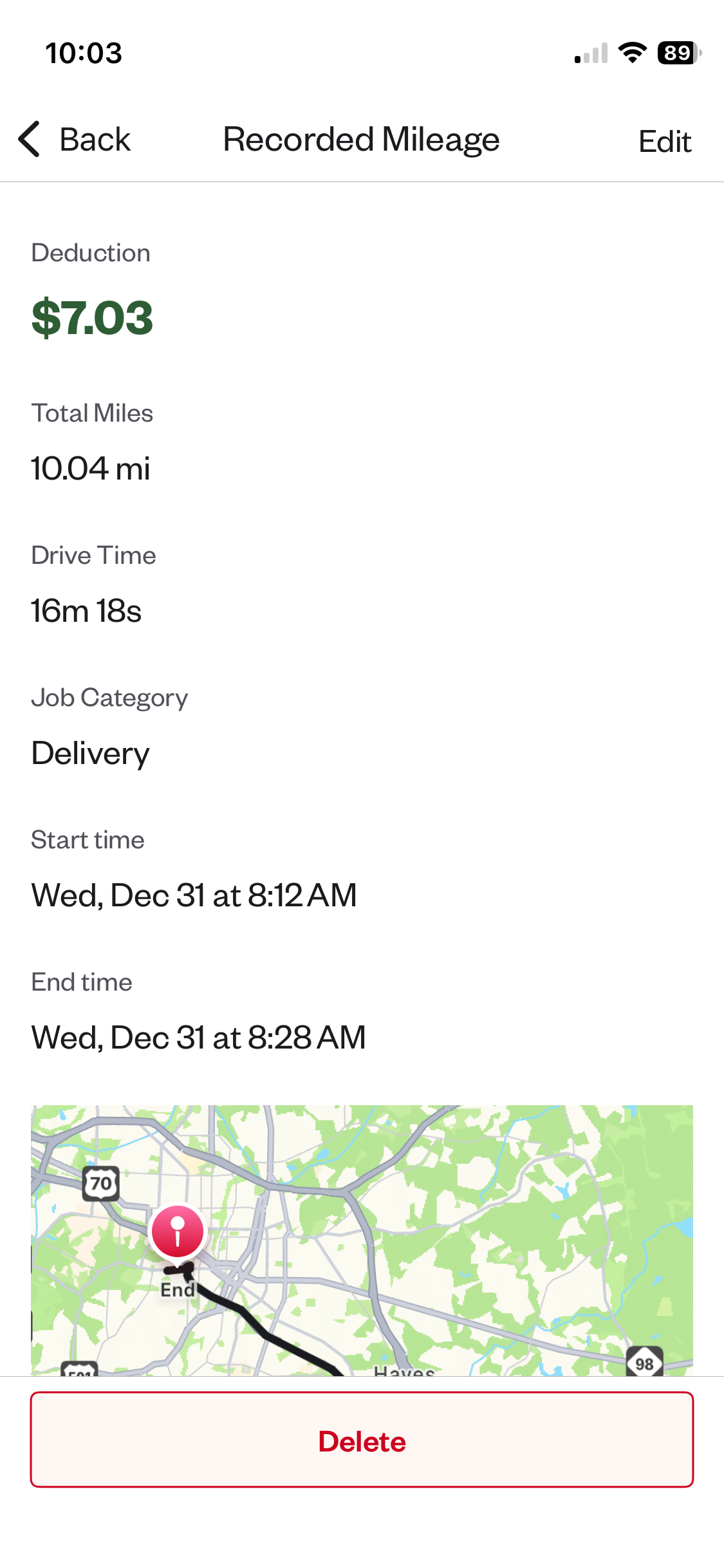
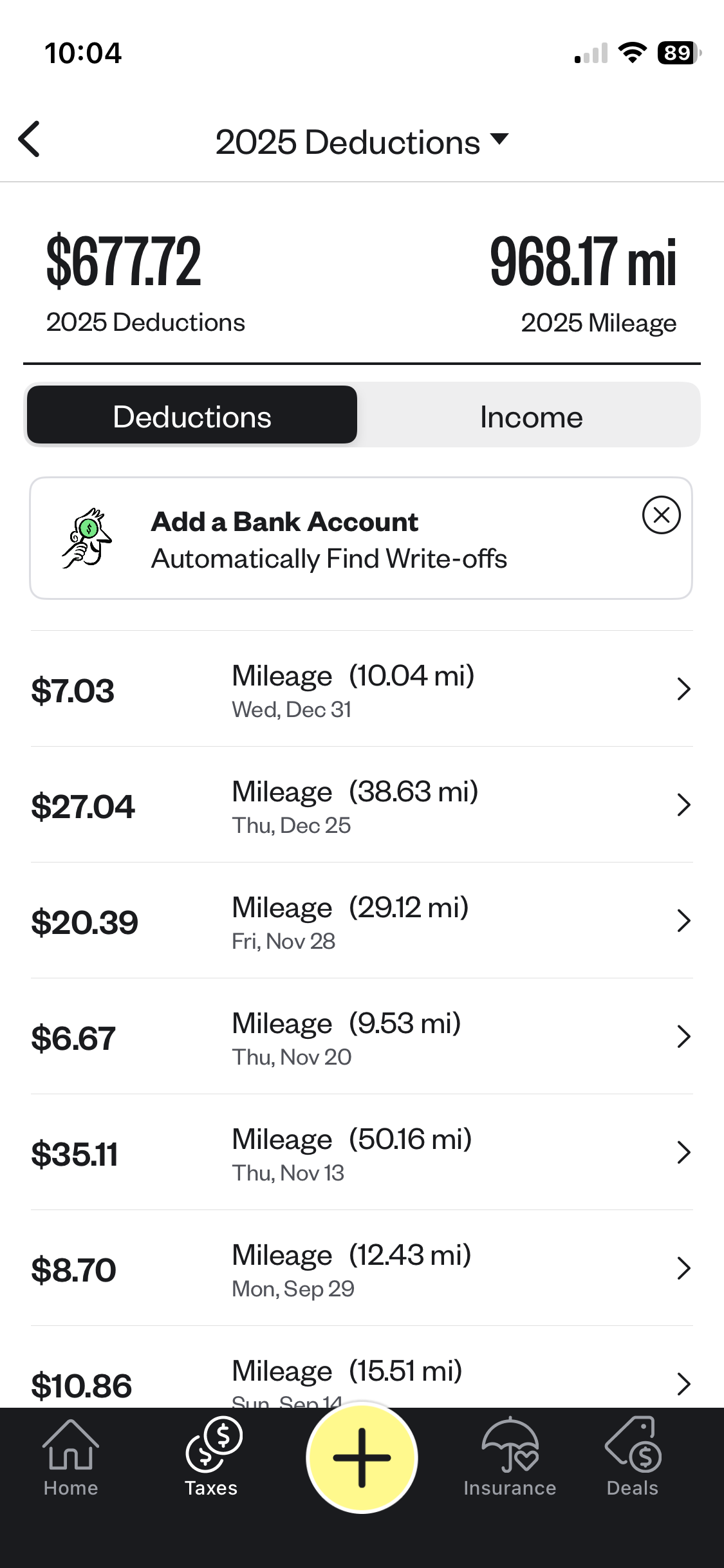
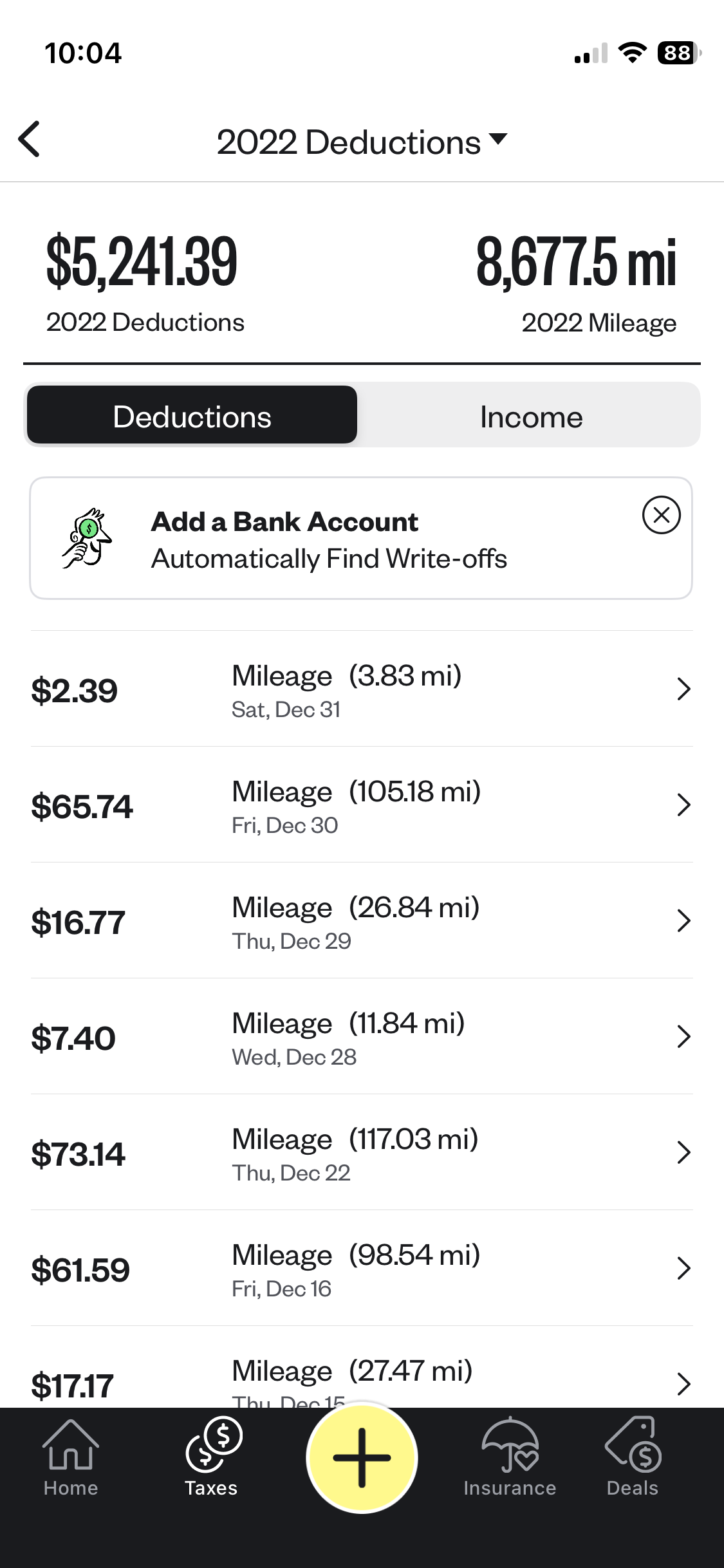
The first image shows what a complete record looks like in the Stride app. (i) We have the start and end time, which covers the date of the trip. (ii) We have a map showing the start and end locations. (iii) We have the total mileage driven. (iv) We have the “Job Category,” which is the purpose for the trip. The other images show the total SMR deduction for 2022 and 2025. In 2022, my business was growing rapidly, but we didn’t own a company vehicle yet. Compare that to last year, which is almost 8x less mileage. There are two main reasons for this. First, we bought a van in 2023, which means I almost never make deliveries with my car anymore. Second, we moved out of my garage and into a commercial space in early 2024. Between the locale and the scale of our operation, we now exclusively have supplies delivered. I no longer run business errands in my car unless it’s an emergency. This is a good example of how mileage deductions naturally decline as a business matures and infrastructure improves.
If you use a company-owned vehicle, mileage tracking isn’t necessary. Instead, the business can expense all ordinary and necessary vehicle costs directly - including fuel, maintenance, insurance, registration, and depreciation. Personal use of a company vehicle must be properly accounted for and is generally discouraged. Since you’re expensing the vehicles costs directly, you can’t also use the SMR deduction. It’s one or the other.
Related Articles
What is Business Personal Property Tax (BPPT) for Your Microgreen Farm?
3 Software Tools for Offloading Work at Your Microgreen Farm
Share this post: